Cistus x escartianus 1681
Author: Jean-Pierre Demoly (1951-)Family: Cistaceae
Genus: Cistus
English name: Escart's rockrose
Zone: Mediterranean
Description
This is a hybrid plant coming from Cistus creticus and Cistus heterophyllus ssp carthaginensis. Both parents do not overlap their range in any territory known to date. However, it is observed that the coexistence of these two plants outside their natural habitat allows the crossing between them, generating a fertile hybrid with great vigor in its development and reproductive stage.
Botanical Description
This is a shrub 40-80cm, erect, very branchy. The twigs are with dense indumentum of long simple, fasciculated, stellate hairs, with some glandular hairs sparsely distributed.
The leaves are of highly variable size, petiole 5-10mm with long simple hairs on the margins of the point of attachment to the stem, blade 5-55 x 5-25cm, the upper subsessile, ovate, ovate-lanceolate, elliptic or oblong-elliptic, watery, rarely subobtuse. The margin is somewhat wavy, somewhat crenate, slightly revolute, with a large, patent and very marked midrib, two laterals much less marked, pinnate venation and netted veins. The upper surface and underside are covered with sparsely distributed stellate hairs, arranged more densely on the underside, occasionally with some fasciculates on the upper midrib and only with simple hairs at the point of insertion of the petiole with the stem.
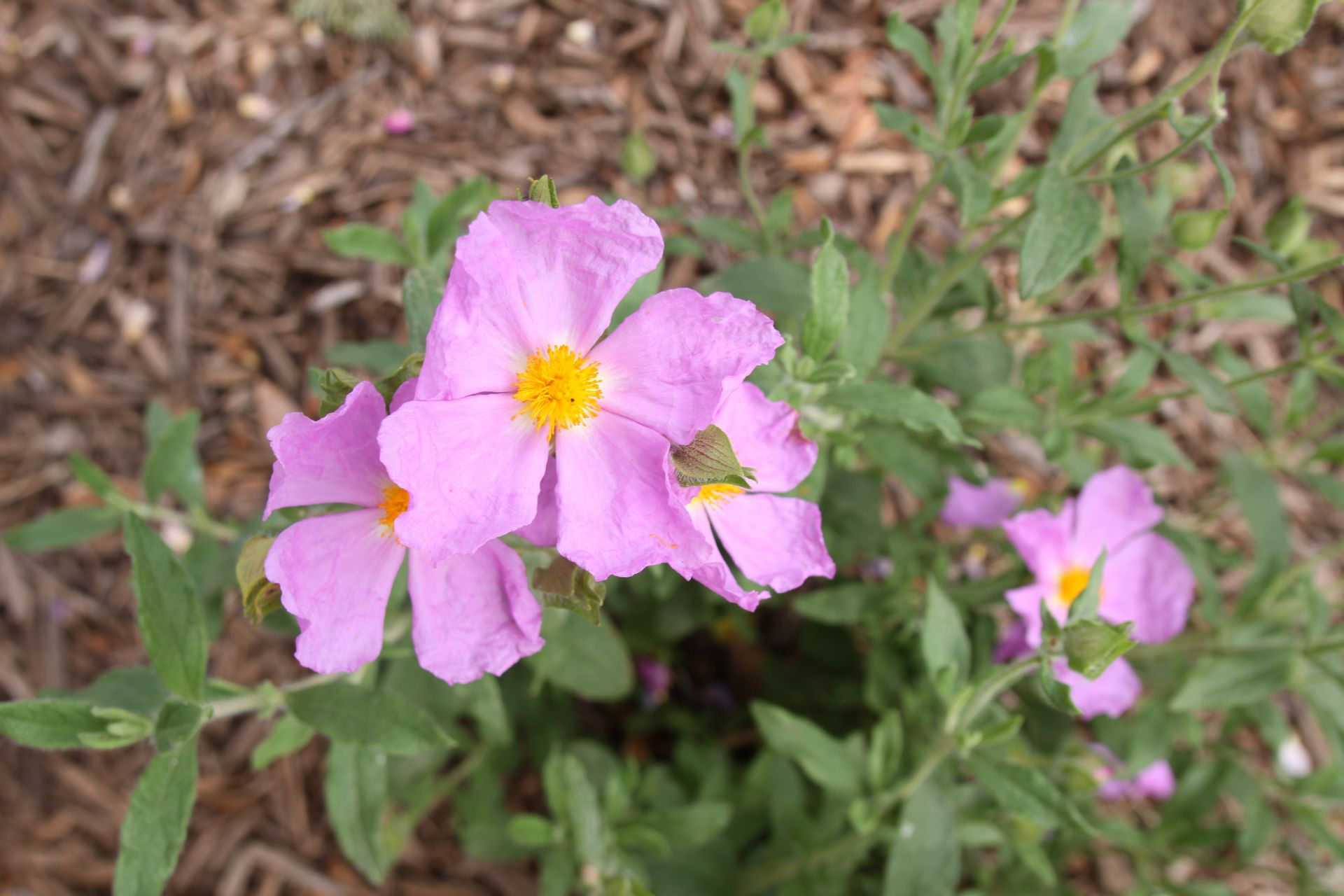
The inflorescence is in a terminal top, few-flowered, 1-6 flowers, some flowers with the presence of bracteoles, with abundant long, fasciculated and stellate simple hairs. The flowers are 5-5.5cm in diameter, pedicels 10-30mm. There are 5 sepals, 14-16 x 10-12mm, subequal, ovate-lanceolate, the two outermost with the outer face densely covered with stellate hairs evenly distributed and few long simple interspersed hairs, inner face with densely simple hairs. They are arranged in the basal three quarters and stellate in the apical quarter, margins of the inner face with stellate hairs, simple and long. The intermediate sepal is pointed, with the external face with stellate, fasciculated and simple hairs, glabrous and shiny internal face in two longitudinal parts and the rest with an indumentum of simple and fasciculated hairs and stellate on the margin. The two inner sepals are more abruptly pointed, with a completely glabrous and shiny inner face, and the outer face covered with stellate hairs, with the presence of fasciculated hairs and some simple ones interspersed. The petals are 25 x 18-20mm, pinkish-purple in color, with a yellow basal spot 4mm long. It has subequal stamens. The ovary is hairy. The style is 1.5-2mm higher than the stamens, stigma convex, slightly five-lobed.
The capsule is 7-10mm, ovoid, hirsute, dehiscent into 5 valves. There are numerous seeds, 1.2-1.5 x 1mm, densely papillose, light brown in color.
The leaves are of highly variable size, petiole 5-10mm with long simple hairs on the margins of the point of attachment to the stem, blade 5-55 x 5-25cm, the upper subsessile, ovate, ovate-lanceolate, elliptic or oblong-elliptic, watery, rarely subobtuse. The margin is somewhat wavy, somewhat crenate, slightly revolute, with a large, patent and very marked midrib, two laterals much less marked, pinnate venation and netted veins. The upper surface and underside are covered with sparsely distributed stellate hairs, arranged more densely on the underside, occasionally with some fasciculates on the upper midrib and only with simple hairs at the point of insertion of the petiole with the stem.
The inflorescence is in a terminal top, few-flowered, 1-6 flowers, some flowers with the presence of bracteoles, with abundant long, fasciculated and stellate simple hairs. The flowers are 5-5.5cm in diameter, pedicels 10-30mm. There are 5 sepals, 14-16 x 10-12mm, subequal, ovate-lanceolate, the two outermost with the outer face densely covered with stellate hairs evenly distributed and few long simple interspersed hairs, inner face with densely simple hairs. They are arranged in the basal three quarters and stellate in the apical quarter, margins of the inner face with stellate hairs, simple and long. The intermediate sepal is pointed, with the external face with stellate, fasciculated and simple hairs, glabrous and shiny internal face in two longitudinal parts and the rest with an indumentum of simple and fasciculated hairs and stellate on the margin. The two inner sepals are more abruptly pointed, with a completely glabrous and shiny inner face, and the outer face covered with stellate hairs, with the presence of fasciculated hairs and some simple ones interspersed. The petals are 25 x 18-20mm, pinkish-purple in color, with a yellow basal spot 4mm long. It has subequal stamens. The ovary is hairy. The style is 1.5-2mm higher than the stamens, stigma convex, slightly five-lobed.
The capsule is 7-10mm, ovoid, hirsute, dehiscent into 5 valves. There are numerous seeds, 1.2-1.5 x 1mm, densely papillose, light brown in color.
References
- Nuevos híbridos en el género Cistus L. (Cistaceae), Ferrer-Gallego, P. Pablo and Laguna, Emilio. Flora Montiberica 2012 Vol. 52 pag. 60-67. ResearchGate
References for the genus
- Flora iberica, Santiago Castroviejo. 2010 Vol. 3 pag. 320-337. ISBN
- Flora of Turkey and the East Aegean Islands, P.H. Davies. 1984 Vol. 1 pag. 506-509. ISBN
- Les hybrides binaires rares du genre Cistus L.(Cistaceae)= Rare binary hybrids of the genus Cistus L.(Cistaceae), Demoly, Jean-Pierre. 1996 Vol. 54(1) pag. 241-254. Address
- Molecular systematics, character evolution, and pollen morphology of Cistus and Halimium (Cistaceae), Civeyrel, Laure and Leclercq, Julie and Demoly, Jean-Pierre and Agnan, Yannick and Quebre, Nicolas and Pßissier, Cßine and Otto, Thierry. Plant Systematics and Evolution 2011 Vol. 295(1) pag. 23-54. Address
- Systematics, character evolution, and biogeography of Cistus L.(Cistaceae) based on ITS, trnL-trnF, and matK sequences, Guzmá, Beatriz and Vargas, Pablo. Molecular phylogenetics and evolution 2005 Vol. 37(3) pag. 644-660. ResearchGate
- The family Cistaceae in Iraq, Daoud, HS. Address
- Unexpected synchronous differentiation in Mediterranean and Canarian Cistus (Cistaceae), Guzman, Beatriz and Vargas, Pablo. Perspectives in Plant Ecology, Evolution and Systematics 2010 Vol. 12(3) pag. 163-174. Address
- Flora of Turkey and the East Aegean Islands, P.H. Davies. 1984 Vol. 1 pag. 506-509. ISBN
- Les hybrides binaires rares du genre Cistus L.(Cistaceae)= Rare binary hybrids of the genus Cistus L.(Cistaceae), Demoly, Jean-Pierre. 1996 Vol. 54(1) pag. 241-254. Address
- Molecular systematics, character evolution, and pollen morphology of Cistus and Halimium (Cistaceae), Civeyrel, Laure and Leclercq, Julie and Demoly, Jean-Pierre and Agnan, Yannick and Quebre, Nicolas and Pßissier, Cßine and Otto, Thierry. Plant Systematics and Evolution 2011 Vol. 295(1) pag. 23-54. Address
- Systematics, character evolution, and biogeography of Cistus L.(Cistaceae) based on ITS, trnL-trnF, and matK sequences, Guzmá, Beatriz and Vargas, Pablo. Molecular phylogenetics and evolution 2005 Vol. 37(3) pag. 644-660. ResearchGate
- The family Cistaceae in Iraq, Daoud, HS. Address
- Unexpected synchronous differentiation in Mediterranean and Canarian Cistus (Cistaceae), Guzman, Beatriz and Vargas, Pablo. Perspectives in Plant Ecology, Evolution and Systematics 2010 Vol. 12(3) pag. 163-174. Address
General specifications
Indigenous plant
Biological type: plant
Frost resistance: 18ºF
Leaf color: dark green
Flower color: white
No transplantation: Yes
Reproduction mode: hermaphrodite plant whoes flowers produce both male and female gametes
Estimated lifespan: ± 8 years
Indexed Susceptible to the bacteria Xylella fastidiosa The Regional Directorate for Food, Agriculture and Forestry.
Specifications for the Mediterranean basin
Adult size (h x w): 3,6ft x 3,2ft
Sun exposure: full sun (Sun hours: >6h Foliage: evergreen
Growth: fast
Flowering time from April until May
Specific information for our garden
Planting substrate: 30%Compost+30%Coco+40%Sand
Plant watering: 1x a week pH 6.5
Logical sequence of containers for: Perennials; forestry plate 8cm, 1L container, 2L forestry pot, 6L container, 55L container
Propagation is done by cuttings
Ecology in its country of origin
Rainfall: 300-500mm
Frost resistance: 18ºF
Leaf color: dark green
Flower color: white
No transplantation: Yes
Reproduction mode: hermaphrodite plant whoes flowers produce both male and female gametes
Estimated lifespan: ± 8 years
Indexed Susceptible to the bacteria Xylella fastidiosa The Regional Directorate for Food, Agriculture and Forestry.
Specifications for the Mediterranean basin
Adult size (h x w): 3,6ft x 3,2ft
Sun exposure: full sun (Sun hours: >6h Foliage: evergreen
Growth: fast
Flowering time from April until May
Specific information for our garden
Planting substrate: 30%Compost+30%Coco+40%Sand
Plant watering: 1x a week pH 6.5
Logical sequence of containers for: Perennials; forestry plate 8cm, 1L container, 2L forestry pot, 6L container, 55L container
Propagation is done by cuttings
Ecology in its country of origin
Rainfall: 300-500mm
Sowing instructions
SPRING Soak the seeds in warm water of 140°F for 12h. Sow the seeds at 2mm depth in the Well Drained Seed Sowing Mix between 64-72°F. During germination keep the substrate moist and in daylight.
Germination references for the genus
- Cistaceae: a plant family with hard seeds, THANos, COSTAS A and Georghiou, Kyriacos and Kadis, Costas and Pantazi, Christina. Israel Journal of Plant Sciences 1992 Vol. 41(4-6) pag. 251-263. Address
Germination references for the genus
- Cistaceae: a plant family with hard seeds, THANos, COSTAS A and Georghiou, Kyriacos and Kadis, Costas and Pantazi, Christina. Israel Journal of Plant Sciences 1992 Vol. 41(4-6) pag. 251-263. Address
Experiences in the garden
31-10-12A Obtaining 3 plants from nursery Filippi (Cultivated from unknown origin)
25-05-18 3x Dead plant asphyxiate: JTz1-JTz3.